01Warp side (let-off)
These parts hold and feed the warp yarn into the weaving zone at a controlled tension.
- Warp beam
- The large beam on which the warp yarn is wound before weaving.
- Back rest (back beam)
- Guides warp yarn from the beam towards the healds and helps keep tension even.
- Let-off motion
- Releases warp from the beam at a controlled rate as cloth is woven.
- Drop wires (warp stop motion)
- Thin metal pieces hung on each warp end that stop the loom when an end breaks.
02Shedding parts
Shedding separates the warp into two layers so the weft can pass between them.
- Heald frames (heald shafts)
- Frames that carry the healds and move up and down to form the shed.
- Healds / wire healds
- Wires with an eye through which each warp end is drawn; they lift or lower individual ends.
- Shedding tappets (cams)
- Cams that drive the heald frames in simple weaves.
- Dobby or jacquard
- Shedding devices for more complex designs: a dobby controls frames, a jacquard controls ends individually.
- Comber board
- On jacquard looms, the perforated board that guides harness cords evenly to the warp.We make this
03Picking parts (weft insertion)
Picking sends the weft across the loom. On shuttle looms these parts take heavy, repeated impact and are replaced often.
- Shuttle
- Carries the weft pirn across the shed on shuttle looms.
- Shuttle box
- Holds the shuttle at each side of the loom between picks.
- Picker
- The block that strikes the shuttle to throw it across the loom.We make this
- Picking stick (picking arm)
- The arm that drives the picker on each pick.
- Picking tappet / picking cone
- Converts shaft rotation into the sharp picking movement.
- Buffer
- Absorbs the shock of the picker and picking stick at the end of travel, protecting the loom.We make this
- Buffer band (check strap)
- A looped strap that checks and cushions the picking stick.We make this
- Swell
- Applies light pressure to slow the shuttle as it enters the box.
04Beat-up parts
- Sley (slay)
- Swinging assembly that carries the reed and the shuttle race.
- Reed
- Comb-like part that spaces the warp ends and beats each weft pick into the cloth.
- Crank shaft
- Drives the sley back and forth for beat-up.
05Cloth side (take-up)
- Temple
- Holds the cloth at full width near the fell to prevent pulling-in.
- Breast beam
- Guides the woven cloth away from the weaving zone.
- Take-up (emery) roller
- Draws the cloth forward at a set rate to control pick density.
- Cloth roller
- Winds up the finished fabric.
06Drive, stop motions & small parts
- Bottom shaft (tappet shaft)
- Turns at half crank speed and drives the tappets.
- Weft fork (weft stop motion)
- Stops the loom when the weft breaks or runs out.
- Brake, clutch, motor & belt
- Start, stop and power the loom.
- Bushes, rollers, blocks & spacers
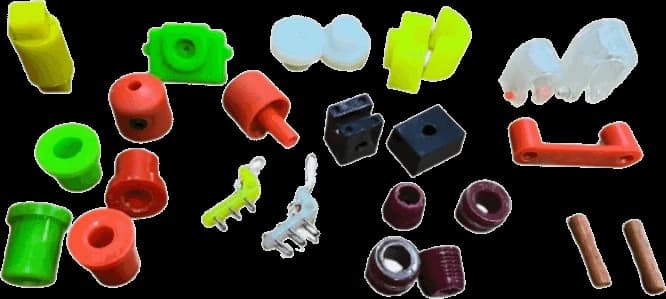
- Small wear parts throughout the loom, often made in engineered plastics.We make this
07Power loom vs shuttleless loom
In Indian weaving clusters, "power loom" usually means a motor-driven shuttle loom: the weft is carried across the warp in a shuttle that pickers throw from one side to the other. The shuttle, shuttle boxes, pickers, picking sticks, buffers and buffer bands in the list above belong to this type of loom.
Shuttleless looms insert the weft without a shuttle, drawing yarn from a stationary package at the side of the loom. They replace the shuttle and picking parts with their own weft-insertion system, but still use many of the same warp and shedding parts: healds, heald frames, reeds, drop wires, temples, and dobbies or jacquards with their comber boards.
- Rapier loom: a rapier head on a flexible tape or rigid rod carries the weft into the shed; on two-rapier looms it is handed over to a second rapier in the middle.
- Air-jet loom: compressed air from a main nozzle, helped by relay nozzles across the width, carries the weft.
- Water-jet loom: a jet of water carries the weft; used mainly with filament yarns that do not absorb water, such as polyester and nylon.
- Projectile loom: a small gripper projectile carries the weft across and is returned to the picking side for the next pick.
Exact part names vary slightly by region and loom make, and rapier, air-jet and water-jet looms replace the shuttle and picking parts with their own insertion systems. If you are unsure what a part is called, send us a photo. We'll identify it for you.